
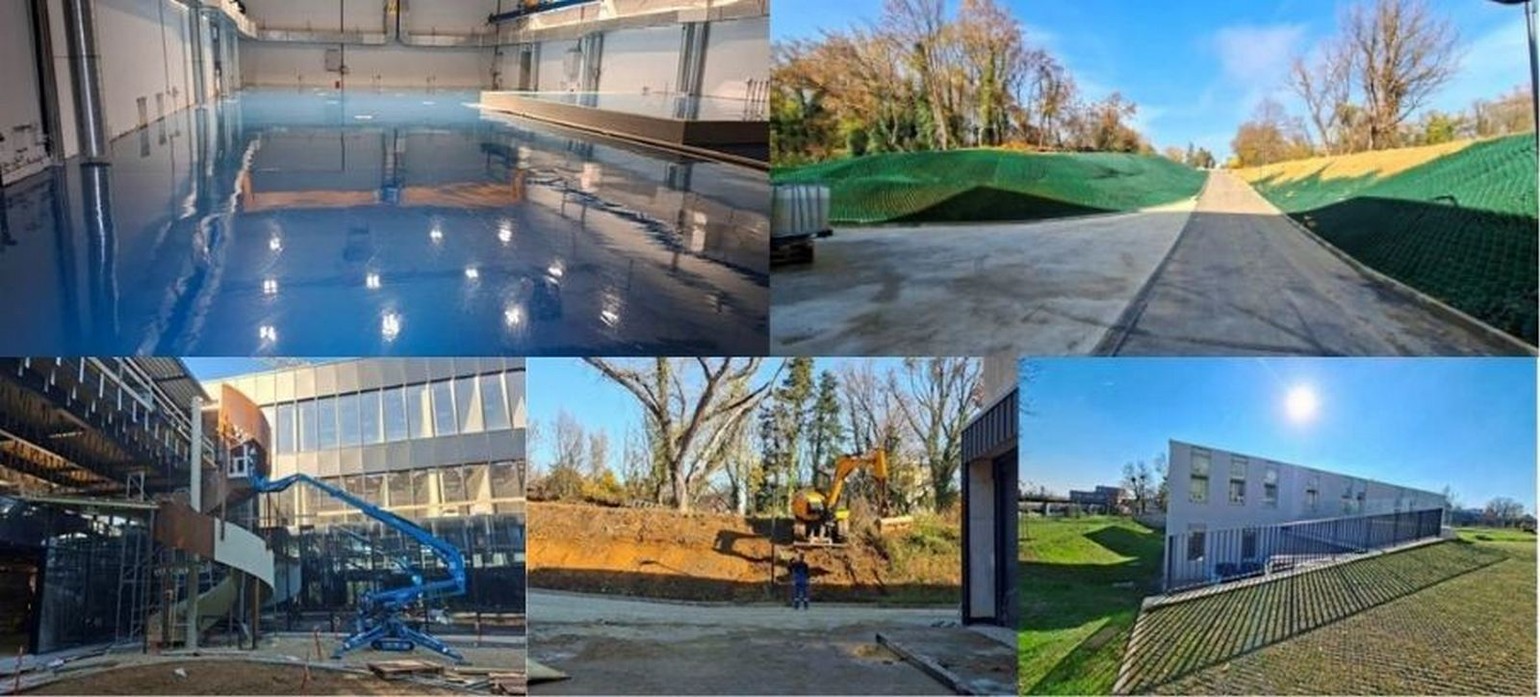
The technical inspections of key parts of the campus — the surroundings (A6), the boiler house (B4), and the ICST building (A1) — have been successfully completed, with no obstacles to issuing the occupancy permits. This is a key administrative step that signals an imminent transition from a multi-year construction site to a functional scientific campus. The occupancy permits for the surroundings (A6), the boiler house (B4), and the ICST building (A1) are issued by the Ministry of Physical Planning, Construction and State Assets.
In the coming weeks, a detailed inspection of the facilities with the contractor has been agreed as preparation for their formal handover. On that occasion, any potential defects will be listed, after which gradual move-in to the boiler house (B4) and the ICST building (A1) is planned. Employees may not work in these buildings before the occupancy permits are issued, but it is permitted to bring in equipment and part of the inventory in order to speed up the move as soon as all required documents arrive.
Hall for the new accelerator (A3): completion of works and arrival of equipment
Although at this stage the main focus is on the surroundings (A6), the boiler house (B4), the ICST building (A1), and the hall for the new accelerator (A3), the project as a whole is clearly structured so that the campus functions as a unified, modernly equipped research space.
Works on the hall for the new accelerator (A3) should be completed by the end of this month. A new blue floor has just been poured in the space, vividly described as the “flooded A3,” which is one of the visible signs that the construction site is approaching its final phase.
An approximate timeframe for the accelerator’s arrival has also been announced: between 15 December 2025 and 15 January 2026. Beyond its logistical complexity, this will be an event of strong scientific symbolism — A3 was designed specifically as the hall to house this key research infrastructure.
The campus energy backbone: North and South substations
Alongside the buildings themselves, major progress is also being made on the energy infrastructure. The North substation near the main gate is ready for takeover, while completion of the South substation is expected by the end of January 2026. These transformer stations are part of the broader PSRM and transformer-station package (D1, D2) and are essential for reliable power supply to the new accelerator, laboratories, and supporting systems.
Without a stable energy network, sophisticated scientific equipment remains nothing more than an expensive exhibit. Completing the substations is therefore just as important a step as the construction works on individual buildings.
Landscaping (A6) and the landscape design report
Along the road toward the hall for the new accelerator (A3), the embankments are protected with a honeycomb structure and will be seeded with grass. This should help prevent soil erosion during heavy rains — an issue that has so far contributed to the impression of a permanent construction site.
In parallel, a new landscape design report is being prepared. An analysis of the current state of trees and shrubs is underway, which will result in a proposal for additional planting and the replacement of everything that was felled or damaged during construction. The team is in continuous contact with heritage conservation authorities, who are fully supportive of this approach.
The idea is that with each completed building, the surrounding area will be landscaped at the same time, so that step by step the “eternal construction site” look is left behind and a pleasant, green campus is created.
Biology and Biomedicine building (A0): progress hidden in the ceilings
The Biology and Biomedicine building (A0) may not yet look dramatically different from the outside, but most of the progress is currently “hidden” in the ceilings. Numerous installations intersect there — electrical, communications, ventilation, and others — forming the invisible infrastructure without which modern laboratories cannot function. This is a phase of the project in which photos often fail to capture the scale of the changes, while inside the building the real technological foundation for future work is being put in place.
A new landscape design report is being produced, including an analysis of the current condition of trees and shrubs, which will result in a new proposal for intensified tree planting and the replacement of everything that has been felled or damaged. We are in contact with conservation authorities about this, and we have their full support. The idea is to landscape part of the surroundings alongside each building.
While awaiting the formal issuance of occupancy permits, the project is entering a phase in which the works are increasingly clearly turning into what the whole effort was initiated for: real laboratories, classrooms, workshops, and green areas in which people will once again work, learn, and conduct research every day.